Books

INTERMEDIA No. 7 (with Harley Lond on the cover)

In order to support this publication, Harley Lond worked at an auto parts store. On the cover of issue no. 7 of INTERMEDIA, he played the role auto maintenance mentor to those who wanted to learn the basics of automobile upkeep.


Books

Harley W. Lond (February 5, 1946 – March 11, 2026): Avant-Garde Editor of INTERMEDIA Magazine

Wednesday, March 11, 2026

(copyright Anna Banana) — “THE NEW DADA BROTHERS” — (Harley Lond, left; Bill Gaglione, right)

Haircut and Concept: Anna Banana

THIS IMAGE IS TAKEN FROM THE FRONT OF THE POSTCARD THAT HARLEY LOND SENT TO LINDA AND ME TWO YEARS AGO FOLLOWING HIS VISIT TO OUR HOME IN LONG BEACH.

Harley W. Lond, one of the major tutelary spirits in the arts magazine renaissance of the 1970s, died early this morning in Lancaster, California, age 80, at home, in the care of his family, according to his daughter, Liz. As founding publisher and editor of INTERMEDIA magazine, in Los Angeles, in the early 1970s, Lond provided both the cross-referencing and the artistic context for artists working in disparate but aligned genres to engage with and nurture each other’s projects and to invigorate the nascent DIY poetics of independent, non-corporate controlled culture.  Gwen Allen’s book from MIT Press, in 2011, included a summary of the impact that the seven issues of INTERMEDIA had on West Coast subcultures.

Lond was born on February 5, 1946, in Los Angeles and attended public schools, graduating with a B.A. in journalism from California State University, Los Angeles. After a road trip with a friend in which both celebrated the improvisational possibilities that were theirs for the asking, he settled back in Los Angeles and by 1973 was involved with the Burbage Theater Company in its new home at the Century City Playhouse on Pico Boulevard. Lond launched a film program and a jazz series to complement the theater’s productions of plays such as “The Devils” and “Robert Patrick’s Cheap Theatrics.”

The bourgeoning art scene and literature scene roused him to begin a magazine that would serve as a rebarbative “clearing house” for those who were seeking kindred spirits to collaborate with. Joining forces with the actors in the Burbage Theater Ensemble, which included a young poet named Bill Mohr, to establish a non-profit arts organization, the Century City Educational Arts Project,  Lond published the first issue of INTERMEDIA in 1974. The CCEAP gained a foothold in San Francisco when Lond moved there in the mid-1970s, and continued his experiment in intermingling the work of poets such as Exene Cervenka with manifesto-like assessments of experimental art.

In the early 1980s, he returned to Los Angeles and settled into a career of editing publications associated with the culture industry, including Boxoffice and The Hollywood Reporter.

He is survived by writer and critic Marilyn Moss and their daughter Liz, as well as several grandchildren: Dahlia, age 11; Sawyer, age 8; and Foster, age 4.

On a personal note, I want to say that I have lost a friend every ten months or so, with a steady regularity that has chipped away at the innermost core of my equilibrium. Up until now, though, I have not lost someone I have known for more than 50 years.

Harley was like a brother to me, and when we met and hugged each other, it was as siblings who knew and respected what each of us had attempted to achieve.

I hope to honor him sufficiently in a memoir I am working on.

Until then, farewell, my dear, dear friend. Rest in imaginative peace.

******************

From: Artists’ Magazines: An Alternative Space for Art
Gwen Allen
The MIT Press; 1 edition (March 4, 2011)

Intermedia

Los Angeles and San Francisco, 1974–1979 (1–7). Editor: Harley Lond.

Intermedia, “an Interdisciplinary Journal of the Arts, Resources & Communications, by and for the Communicator/Artist,” was started by Harley Lond as a kind of yellow pages for artists, writers, and musicians in the Los Angeles area and beyond. Lond wrote in the first issue:

The vacuum in which artists have struggled for years is now being filled by a host of political and economic organizations striving to create a stronger representationand voice for artists everywhere. There is almost a grassroots movement amongst artist to take control over their destinies in the econo/political facets of capitalist society. … One of the goals of Intermedia is to link the new art movement with these other alternative movements—to create a unified alternative force of artists, writers, workers, and radicals. … We want  Intermedia to be by and for artists, to be a forum for artists’ concerns and needs, to be a mode of interdisciplinary communications between the artist and the alternative learning people, radicals, communicators, and especially a mode of communication between artists of different media.

Inspired by Dick Higgins’s Something Else Press, Lond borrowed the magazine’s title from Higgins’s “Statement on Intermedia” (he got the artist’s permission first). Lond, who started the magazine with his savings and donations from family and friends, did all of the layout and typesetting himself, financing the magazine largely through small grants. After moving to San Francisco in 1977, he worked at the counter of an auto supply store, saving money, and then periodically taking time off to publish the magazine. The first three issues were 8½-by-11-inch magazines that included artists’ contributions and writings plus a listing of art services, organizations, small presses, and free artists’ classifieds. The magazine expanded as Lond began to realize the magazine’s potential as an artistic medium: issue 4 was a “Special Literary Issue,” printed as a tabloid newspaper (48 newsprint pages) of experimental art and literature; issue 5 was a tabloid compendium of 17-by-22-inch posters by artists; and issue 6 was a box containing artist-designed postcards, broadsides, folders, and posters. Among its contributors were Martha Rosler, Clemente Padin, Richard Kostelanetz, Opal Nations, Dick Higgins, Anna Banana, and Lew Thomas.

From:

Experiments in Print: A Survey of Los Angeles Artists’ Magazines from 1955 to 1986 (Feb. 6, 2012,  East of Borneo, published by the School of Art at the California Institute of the Arts)

by Gwen L. Allen

… However, the attempt to forge a regional identity became more self-conscious and pronounced in the artists’ magazines of the 1970s and ‘80s. Los Angeles was an especially fertile region for artists’ magazines at this time, giving rise to publications, including the L.A. Artists’ Publication, LAICA Journal, Intermedia, Straight Turkey, The Dumb Ox, Choke, Criss Cross Double Cross, Chrysalis, The Performance Art Journal, and Spectacle. These magazines played a vital role in the experimental practices that defined Los Angeles art during this period, nurturing a local artistic community by fostering dialogue both within and beyond it.

Intermedia exemplifies how artists’ magazines participated in the ideological and practical goals of alternative space, by fostering solidarity and information sharing among artists and other kinds of cultural workers, and supporting artists’ moral and legal rights. Billed as “an Interdisciplinary Journal of the Arts, Resources & Communications, by and for the Communicator/Artist,” the magazine was published and edited by Harley Lond, who conceived of it as a kind of Yellow Pages for artists, writers, and musicians in the Los Angeles area and beyond. Intermedia included a listing of art services, organizations, small presses, and free artists’ classifieds. As suggested by its title, the magazine also supported conceptual and intermedia practices, which it showcased in different formats, ranging from an 8½-by-11-inch magazine to a tabloid newspaper; a compendium of posters; and a box containing unbound artist-designed postcards, broadsides, folders, and posters. Among its contributors were Martha Rosler, Clemente Padin, Richard Kostelanetz, Opal Nations, Dick Higgins, Anna Banana, and Lew Thomas.

And also see What We Need Are These Early Experimental Art Magazines From the West at the Poetry Foundation’s website.

Books

Forthcoming in April: “Allen Ginsberg in Context” (Cambridge University Press)

Erik Mortenson, the editor of “ALLEN GINSBERG IN CONTEXT,” recently shared the precise date of a book of essays on the work and life of Allen Ginsberg, one of the most provocative, controversial, and influential American poets of the 20th century. I first saw Ginsberg read when he was on a West Coast tour in the spring of 1968. Glover Davis and John Theobald were the primary specialists on the faculty at that time. Although Theobald was British, he had emigrated to the United States as a young man and taught on the East Coast for a decade, during which he became friends with Robert Frost and Ezra Pound. He was on the verge of retirement when I took a survey of poetry course with him; the syllabus did not include Ginsberg. Davis, on the other hand, assigned Donald Allen’s anthology as part of our reading as well as a New Directions paperback of William Carlos Williams’s Selected Poems. Several hundred students attended Ginsberg’s reading, in which he read “Wales Visitation” with a zestful lilt. The poem would not appear in print (in the New Yorker magazine) until mid-May, so everyone in the audience was experiencing the poem without any previous exposure to it. Remarkably, even Theobald was impressed. In the first class after Ginsberg’s reading, he made a point of praising that poem, though I have my doubts that he knew the poem’s inspiration was accelerated by ingesting LSD.

Getting close to 60 years after hearing Ginsberg read for the first time, I am honored and delighted to be among the contributors selected by Erik Mortenson for ALLEN GINSBERG IN CONTEXT, which will be published by Cambridge University Press on April 23. Other contributors who also wrote chapters for this volume include Stephen Gould Axelrod, Steven Belleto, Rona Cran, Terence Diggory, Stephen Fredman, Kurt Hemmer, Barry Miles, Stephen Paul Miller, Daniel Morris, Peggy Pacini, Jonah Raskin, Anne Lovering Rounds, Steven Taylor, John Whalen-Bridge, David S. Ills, and Antonin Zita.

https://www.cambridge.org/core/books/allen-ginsberg-in-context/FE298C2B4984970822945A5DCF9EAE16


Books

Ed Foster (1942-2026): Poet, Publisher, Literary Critic

Ed Foster: The Poetics Laureate of Talisman House

February 22, 2026


As far as I can tell, Ed Foster’s literary archive, encompassing his writing as a poet as well as all of his editorial projects, remains on the market and has not yet settled into the special collections of a university library. I suppose eventually his papers will find a secure residence for scholars to make us of, but until they are available, the nuances of Foster’s contributions to avant-garde poetry over the past half-century will remain unaccounted for in any literary history of contemporary poetry. In the meantime, we do have several interviews with Foster available on-line to help tether the oncoming avant-garde in poetry with the culminating provocations of the writers that Foster published through Talisman, his publishing project.

The list of poets Foster devoted attention to is among the most diverse avant-garde ensembles featured by any post-World War II independent publisher: Leslie Scalapino; Paul Vangelisti; Susan M. Schultz; Samuel Menarche; Michael Heller; Dennis Phillips; Timothy Liu; William Bronk; Burt Kimmelman; Elinor Nauen; Alice Notley; Ron Padgett; Stephen Paul Miller; Dodie Bellany; Gerrit Lansing; Leonard Schwartz; and Gustaf Sobin.

Along with James Sherry of Roof Books and Douglas Messerli of Sun & Moon Press, Foster embodied a selflessness as a cultural worker that is all the more remarkable in the larger context of institutionalized aggrandizement represented by the self-promotional efficiency of enterprises such as AWP. Neither Sherry, Messerli, nor Foster appear in A POETICS OF THE PRESS: Interviews with Poets, Printers, & Publishers, edited by Kyle Schlesinger, which was published five years ago, but that should not be taken as an indication of any neglect by Schlesinger, whose protagonists include Keith and Rosemary Waldrop, Lyn Hejinian, Johanna Drukcer, and Charles Alexander. If anything, I would encourage everyone to read Schlesinger’s book (published by Cuneiform Press and Ugly Duckling Press) before clicking on these links to interviews with Foster.


INTERVIEWS AND REVIEWS: ED FOSTER


http://www.tygersofwrath.com/EdwardHalseyFosterInterview.htm

Interviewer: Rob Couteau


https://yaleunion.org/secret/Howe-Talisman-interview.pdf


For background information on the books published by Ed Foster through TALISMAN:

https://talismanbooks.org/Edward-Foster


For a list of the contents of Ed Foster’s archive, see:

https://granarybooks.cdn.bibliopolis.com/images/upload/talisman-prospectus-gb.pdf


For a review of Ed Foster’s NEW AND SELECTED POEMS:

https://archive-vol-ii.weebly.com/ed-foster.html#:~:text=His%20terse%20language%20and%20short,most%20felicitous%20in%20short%20poems.


Ed Foster Interview

http://www.tygersofwrath.com/EdwardHalseyFosterInterview.htm


Books

“Poem” by William Carlos Williams (or would a cat looking in a mirror while crossing a jamcloset recognize herself?)

Let’s imagine William Carlos Williams’s “Poem” running backwards, as in a film that reverses itself:


Into the pit of

the empty

flowerpot


the cat first

dipped

carefully


the right

forefoot then the

hind


as it climbed

over the top of

the jamcloset

****


When “Poem” is inverted with a slight amendment to facilitate the syntax, the word “top” emphatically pulls the camera’s concluding shot. The trajectory becomes an ascent: the escape from the “pit” of the empty flowerpot conjoins with a sense of triumph at the summit of the poem. Not only is it a much less subtle poem when it’s inverted, but it also leaves one wondering about what the effect would be if the entire “jam closet” stanza were cut from the poem.

I, of course, prefer WCW’s version of the poem, though I must say that what took me years to notice and write about in an article for the William Carlos Williams’s Review — that the key word in the poem is “pit” — would probably have gotten more attention from previous commentators if it had been in the poem’s first line.


Books

Michael Silverblatt: KCRW’s “Bookworm” (1952-2026)

Michael Silverblatt: The Quintessential, Omnivorous Reader and Compassionate Interviewer

February 15, 2026

The LA Times has posted an obituary for Michael Silverblatt, the legendary interviewer of authors on the Santa Monica-based radio station KCRW. The article stated that Michael died yesterday, at age 73.

Born in Brooklyn, and educated at the State University of New York, Buffalo, he arrived in Los Angeles around 1977. I first met him when he was living in Santa Monica in an apartment just north of Wilshire Blvd., and about halfway between Intellectuals & Liars Bookstore and the Palisades Park. Michael frequented that store and its reading series throughout the summer and fall of 1978, during which time I was running the reading series and putting together an anthology of Los Angeles poets entitled THE STREETS INSIDE. I held a New Year’s Eve party to celebrate the book’s publication at my apartment in Ocean Park and invited Michael to it, at which point he had his first extended conversation with Jim Krusoe. Michael began visiting Jim’s apartment, which was barely more than a hundred yards from my place, on a regular basis, and quickly found himself to be a rising star in a literary firmament that was by that time attracting the attention of a younger generation of poets such as Dennis Cooper and Amy Gerstler, who were gravitating to Beyond Baroque Literary Arts Center, in Venice.

Michael, however, was forced to recognize eventually that his most passionate identity — that of an extraordinarily close reader of novels and poems — was the way that he would best be able to make a memorable contribution to the Republic of Literature. “Bookworm” was his destiny, and only his friends from those early years truly comprehended the arduous journey he undertook to bring it about. No tenured professor ever endured an equivalent regimen of graduate students and unpaid adjunct work as daunting as that which Michael submitted himself to. The admiration writers felt for him was earned at an enormous price, but the secret triumph was how Michael always shifted that admiration elsewhere by implicitly urging listeners to attend to larger cultural issues. If he made a penetralia out of overlooked details in a writer’s work, he did so not to show off his remarkable acuity as a reader, but to encourage others to dig even deeper into themselves to discover how a book might restore a semblance of legitimate order to the disorder of contemporary life.

If the end is in one’s beginning, it is perhaps appropriate that the last time I saw him was at Beyond Baroque, speaking with great fondness for his memories of those early years, as he addressed a gathering in honor of the late poet and novelist Kate Braverman that had been organized by novelist Janet Fitch.

R.I.P., Michael. I still remember you at the party on Hill Street, New Year’s Eve, looking like someone for whom the new year meant that you had finally begun to find your niche.

https://www.latimes.com/california/story/2026-02-15/michael-silverblatt-dead-kcrw-bookworm-host-73?sfmc_id=6532a4c325b3640666c6aaca&utm_id=44142765&skey_id=37c43a5c3a11da12bdc55f9c622d0baf0ec7493490d9327a7099d22dd53e6a5e&utm_source=Sailthru&utm_medium=email&utm_campaign=ALERT-Email-List-Michael%20Silverblatt%2C%20%27genius%27%20host%20of%20KCRW%20literary%20show%20%27Bookworm%2C%27%20dies%20at%2073-20260215&utm_term=Alert%20-%20News%20and%20Entertainment

I would then recommend you turn to KCRW’s special show on Michael’s tenure as their resident professional reader.

https://www.kcrw.com/shows/bookworm/stories/remebering-kcrws-bookworm-michael-silverblatt

https://en.wikipedia.org/wiki/Bookworm_(radio_show)

UPDATE: A week after his death, The NY Times has also posted an obituary. Given that New York City is the home base for the mainstream commercial book industry, and that Michael’s astute advocacy of novelists and poets also immensely benefitted their publishers, it is only fitting that Michael receive the honor of an obituary in the New York Times. As testified to by my account of his arrival in Los Angeles, Sam Roberts got the date wrong by which time Michael first settled in Los Angeles. Nevertheless, I thank him for mentioning other details that have been left out of other obituaries, such as his disenchantment with both academic life at Johns Hopkins as well as the haughty choke-chain of editorial exclusiveness in the New York publishing scene. If Los Angeles is a haven for those for whom self-invention is a necessity, then L.A. indeed redeemed its literary soul by giving Michael a chance to lift all of our spirits, whether the reader was in Duluth, Minnesota; Jackson Hole, Wyoming; or Albuquerque, New Mexico.

(Updated February 21, 2026)

https://www.nytimes.com/2026/02/20/books/michael-silverblatt-dead.html


Books

“Catching Fire”: Anthology Launch, January 31st, at Beyond Baroque


Please join me in supporting this book project, edited by S.A. Griffin and Richard Modiano, which has already raised through its sales a couple of hundred dollars on behalf of two recovery efforts.


Books

“Local” artist? Local?

I have heard myself referred to as a “local” poet, a phrase that almost implicitly is meant to diminish the status of any artist or poet. Of course, I am hardly the only one besmirched with that term. I remember giving a talk at the Getty Research Institute in the fall of 1996 about the poets of Venice West and being challenged about the value of their insularity. “Who wants to be local?” Michael Roth asked me in front of a roomful of professors who were known for their scholarship on the city of Los Angeles.

At the time, I didn’t have an answer that adequately provided an escape hatch from my seeming intellectual provinciality. The point of the year-long seminar I was part of for a few months was to examine Los Angeles as a primary instance of what Peter Schjeldahl called a “transmission city,” a status long accorded New York, Paris, and London. The culture industry, with its global capacity to replicate hypnotic cinematic images, made readers of literary magazines with circulations of less a thousand people seem utterly irrelevant. That poets wanted to generate a gift exchange economy in direct opposition to the corporate seizure of cultural capital was regarded as too confined to be a serious strategy. Such an evaluation had consequences: a person sitting by herself, and reading a book published by Red Hill Press or Bombshelter Press or Momentum Press or Little Caesar Press or rare avis press or Mudborn Press was not endowed with any sliver of literary enfranchisement; in the 1970s, and yet… (yes, let’s pause here…) and yet it was poetry published by dozens of “local” small presses around the country that largely set in motion the multiculturalism that eventually aroused demands known as DEI. The fact that the backlash has been so ferocious in the past decade only shows that the “local” efforts of small presses and independent arts organizations (including Beyond Baroque, the Woman’s Building; the World Stage; and Tia Chucha) have been more than coterie efforts. Their antagonism toward centralized control of culture has earned its place as a form of pragmatic resistance.

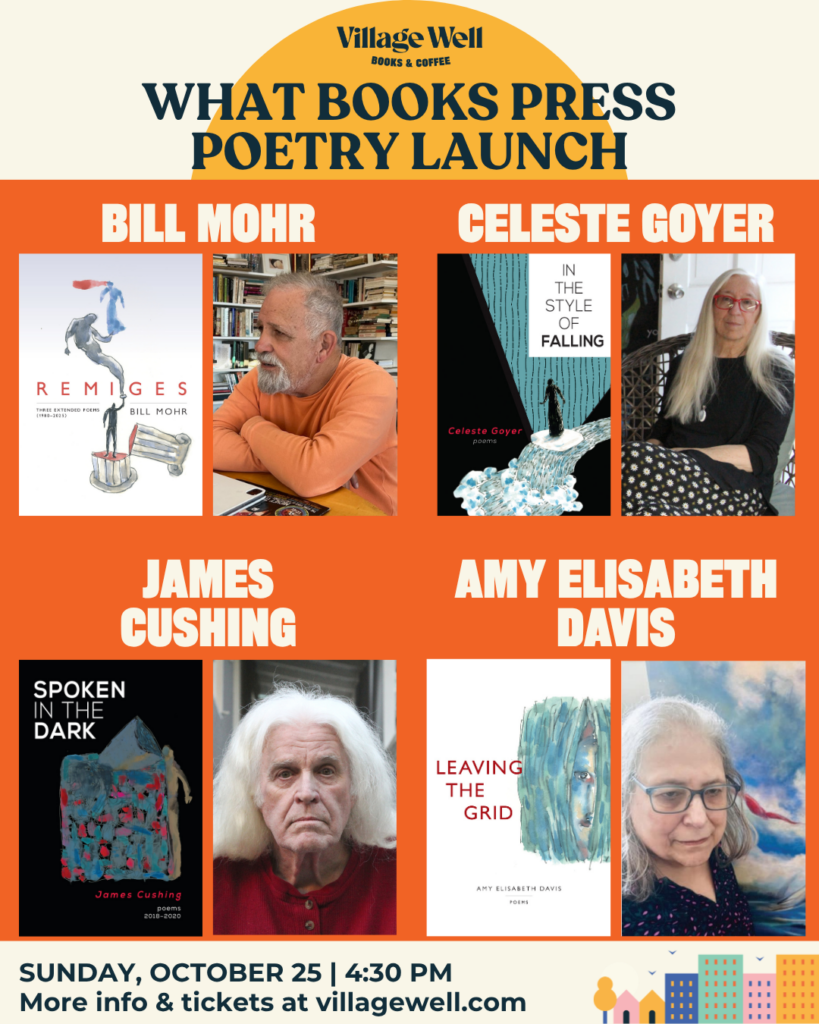
In particular, I would like today  to point to an example of a publishing project launched by Harry Northup and Holly Prado that is still at work: Cahuenga Press. While subsequent collectives, such as What Books, have emerged and made an enormous contribution to a vivacious literary ecosystem imbued with nektonic energy, Cahuenga has distinguished itself with a series of volumes that directly confront the issue of being “local.”

Here is an early flyer. As briefly as I was a working contributor to this project, it remains one of the efforts I am most proud to have helped get underway.


Books

Cathy Colman — Tribute at Beyond Baroque (Video)

On Sunday afternoon, December 7, 2025, Los Angeles area poets gathered at Beyond Baroque to read some of Cathy Colman’s poems. Colman was educated at San Francisco State University and she received her M.A. degree there in the mid-1970s after studying with Stan Rice. The poems in her M.A. these were already mature, memorable pieces of work and were far more substantial than one might expect of a person at her age.

Colman’s first book, BORROWED DRESS, did not appear until she was 40 years old, however, when her manuscript won the Felix Pollak prize from the University of Wisconsin Press. The book was popular enough soon after its publication that it made the Los Angeles Times bestseller list. Her poems were also gathered in two other collections, BEAUTY’S TATTOO (Tebot Bach) and TIME CRUNCH (What Books). Some of the magazines her work appeared in included Colorado Review, Ploughshares, The Gettysburg Review, and Plume. Her poems were also translated into Italian, Russian, and Croatian.

CATHY COLMAN
June 16, 1951 – April 30, 2025
BEYOND BAROQUE’S RECORDING OF THIS MEMORIAL EVENT:

(THE PROGRAM ON THE VIDEO DOES NOT BEGIN UNTIL ABOUT 17:17, so simply guide the red button to that point and Elena Karina Byrne will appear on the screen as one of the prime organizers of the event.)

I had hoped to attend, but I am no longer able to make long trips around Los Angeles two days in a row anymore. I had been at both DTLA and Beyond Baroque the day before, and traffic had been exhausting. Everyone at the Beyond Baroque event had spent at least an hour and a half getting to the event from where they lived.

The poem I had planned to read, if I could have attended as originally intended, was “While Deuterium and Tritium Spread,” which begins with an image from the 1950’s Cold War:

through animal and mineral, braiding
through my hair,
throwing open the window to the sky’s
cracked plate
of oysters and pearls, as

the clouds’ gold isotopes sail
through middle air’s
muddle, I can smell the wet pavement
from childhood rain

The poem ends with the kind of understatement that makes a theater script the most tantalizing form of imaginative literature. “the future waits offstage.” One feels the tremor of an haunting cue about to be spoken, and the effort it takes stay calm even as one knows that this Vesuvius will have a tsunami of lava that will obliterate almost all life on the planet.

Many of the poets who spoke at this event had known Cathy for years and spend considerable time with her or had studied at UCLA Extension with her or in private workshops, but I had hardly known her. I recollect once talking with her in the lobby of Beyond Baroque for about five minutes. Only afterwards did I revisit Suzanne Lummis’s WIDE AWAKE anthology and realize that Colman was inexplicably not in that collection, which came out in 2015. Colman was in Lummis’s most recent anthology, however, POETRY GOES TO THE MOVIES. with a two-page, three-part poem, dedicated to Chantal Akerman, entitled “News from Home.”

Colman’s metaphorical dexterity was on full display in the poems that her friends chose to read. One in particular stood out: “Happiness is a houseguest with an amiable smile after using all of the hot water to take a shower.” I don’t have the poem that image is from so that I can quote it exactly or with line-breaks, but I’ve not often encountered such a droll assessment of the motive and opportunity of happiness’s role in our lives.

Listening to Colman’s poems being read by her friends, nevertheless, will help assuage the sudden loss of yet another outstanding poet in Los Angeles.

Many thanks go out to Leslie Campbell and Elena Karina Byrne for making this event happen.

Books

Will the Typewriter Poet of 2025 Be Famous for More Than a Quarter-Hour?

“o po-ets, you should getta job.” — Charles Olson

And if no one will pay you more than minimum wage, why not just set yourself for hire?

Meet the Long Beach typewriter poet helping strangers navigate heartbreak

As a thought experiment, imagine the Venice Boardwalk with fifty such individuals as Nico Patino offering to write a poem for anyone who stopped and requested one. It’s probably the case that Patino would get more requests than many of the other poets. There are several conjectures I could offer about why Patino would attract more passersby, but all of them involve trust. It’s not that easy to write a poem that doesn’t judge the subject of the poem with words “not untrue and not unkind.” With that talent at work, Patino has become the founder of “The Predisposed School of Poetry.” I don’t mean the title of this school in any way to disparage Mr. Patino. In fact, I hope he pounds out a short statement along the lines of O’Hara’s “Personism” that he will attach to his first self-published collection.

I cannot help but admire him.