Books

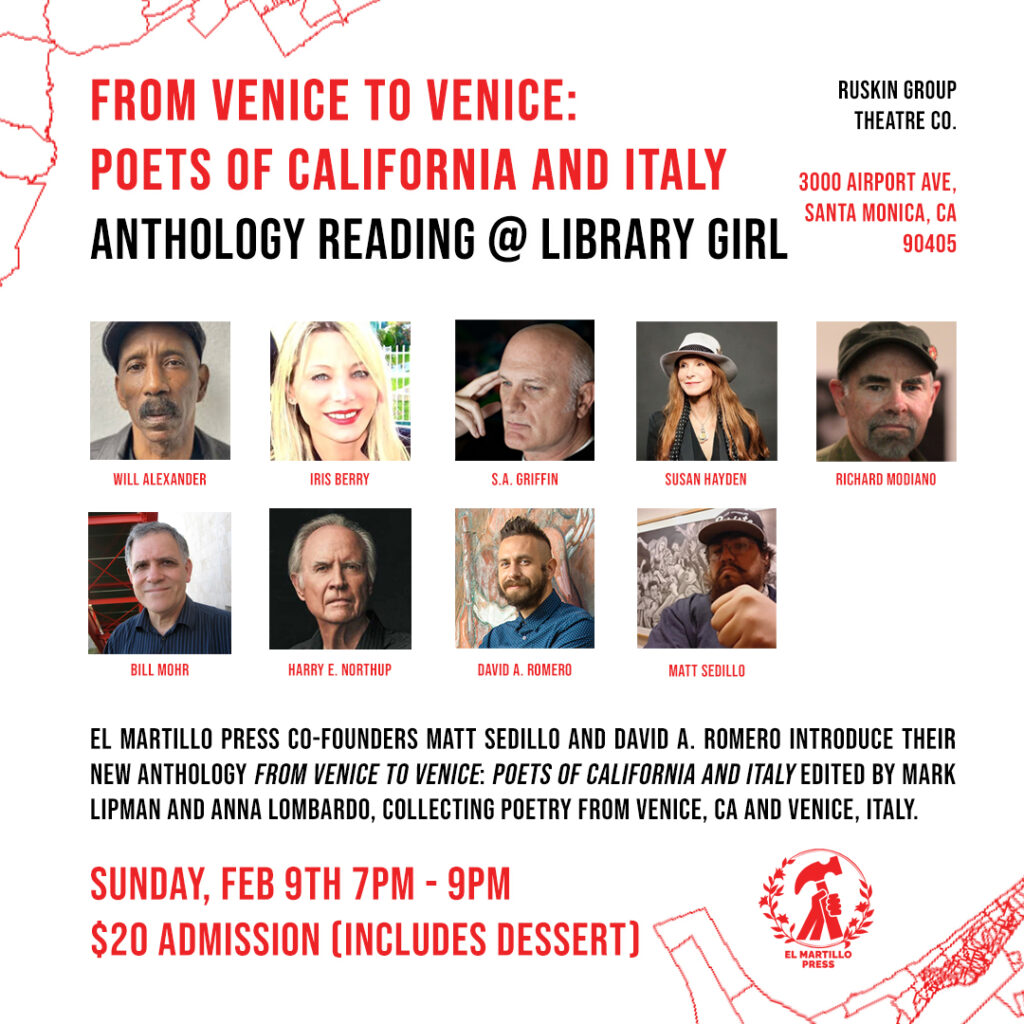
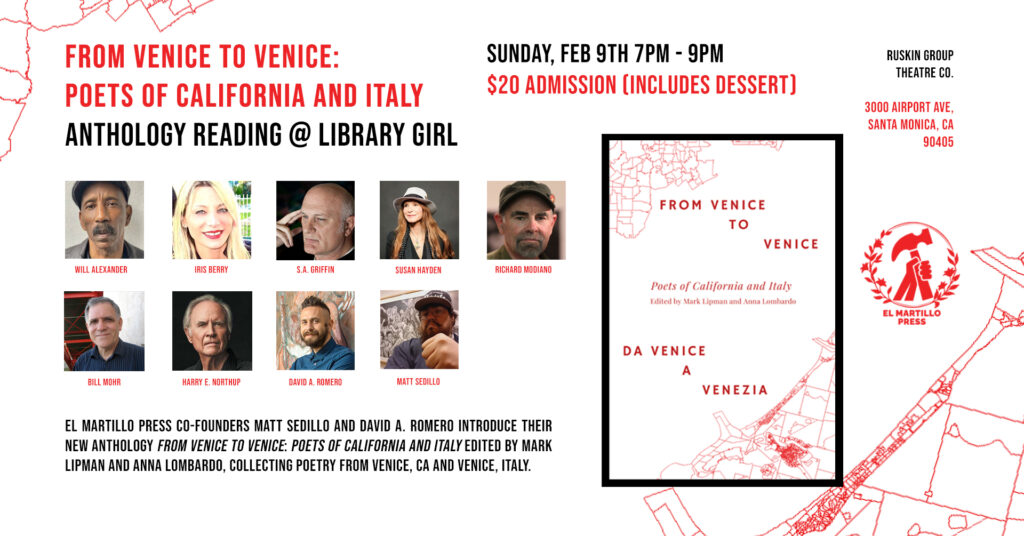
NEXT SUNDAY – The Ruskin Theater Reading for VENICE Poets (California and Italy)

Over the past half-century, I’ve given readings both as a solo featured poet as well as being paired with some of my favorite poets. The upcoming reading at the Ruskin involves several poets whose work I have long admired, and it’s an honor to read with them on the occasion of celebrating this anthology.


FROM VENICE TO VENICE


FROM VENICE TO VENICE

Books

“Broken English”: Marianne Faithful as “Lady Lazarus”; and other obituaries

January 30, 2025

One coincidence that has not nearly been noted enough is that Sylvia Plath died the same day that the Beatles recorded the bulk of their first album. When I mention this to students, as I did this very morning in a lecture on Plath, I point out that had Plath not died that day, she most likely would have been headlining the bill at the poetry festival at Royal Albert Hall a couple of years later. Having gotten home and heard the news reports of the death of Marianne Faithful, I am moved to pay her tribute by saying that Faithful was a kind of “Lady Lazarus” herself, an artist who took great risks. In particular, I am thinking of her album “Broken English” and the exquisite, haunting title track.

It’s a grim day, though, on an even larger scale for the sport of figure skating. This is the second time in my life I have heard of a group loss in this sport. In fact, the plane crash that killed so many members of the U.S. skating team on February 14, 1961 may have been the first time I was really made aware of the risk involved in aviation. I was 13 years old when I heard that 18 skaters and six coaches, as well as team officials and family members, had been killed in a crash near the Brussels, Belgium airport. Just two weeks earlier, the U.S. Figure Skating Championships had been held in Colorado Springs, an event broadcast on national television.

Not a grim day. A harrowing day, especially when one pauses and ponders the fact that one out of every 50 people who were alive in Gaza sixteen months ago has been killed by this point. I doubt that even one of the 18,000 children killed would have grown up to be a figure skater, but can we not imagine how much pleasure many of them would have gotten out of playing soccer with each other. Now that’s a field of dreams obliterated beyond the recuperative possibility of any redemption. I suppose W.H. Auden was right: “Those to whom evil is done./ do evil in return.” Indeed, a harrowing day.

Will it be any different in 2030? 2036? 2040? 2050?

How can it be different when the government of Saudi Arabia executes a legal American resident and dismembers him because it objects to his criticism? And one can hardly forget the Charlie Hebdo murders.
https://en.wikipedia.org/wiki/Charlie_Hebdo_shooting

Or the breaking news of the murder of a man in Sweden who protested the abuse of Christians in countries dominated by the Islamic religion.

Or the repeated attacks on Salman Rushdie!

Or the recent terrorist attack in New Orleans, done in the name of ISIS.

Not to mention what is happening in Sudan…..

Surely my warm meal and my warm bed are illusions, to be enjoyed for their very frailty.

Books

Cantilevered on Kauai

Linda and I are not the couple perched on a cantilevered peninsula of ground that is being slowly devoured by te oscillation of tides. However, we did enjoy talking several walks with our generous hosts, Nicole and Erik, who provided us a room to stay in in their house and many scrumptious vegetarian meals.

On the final full day there, we went to a site with 88 Shino Buddhist shrines as well a play staged by the local theater group, and then we had a dinner across the street at Kathy and Patrick’s house. Katy’s sister had died about eight years ago, and when Linda and I last visited Kauai, I wrote a poem that Kathy framed a handwritten copy of and put on a wall in her home. I he’d heard she has done this, but it was gratifying to see it actually given a place of honor in her home.

Thank you to all wo made our trip so memeoble, including Helen, wo made beautiful leis for us once again.

Books

THREE GROUP PHOTOGRAPHS OF L.A. POETS (early to mid-1980s)

The poets who appear in these three group shots all contributed poems to my anthology: “POETRY LOVES POETRY” (Momentum Press, 1985). Five of them also were featured poets in my anthology, “THE STREETS INSIDE: Ten Los Angeles Poets” (Momentum Press, 1978), which Robert Kirsch praised in the Los Angeles Times as indicating a “golden age” in Los Angeles poetry. These three group photographs respectively appeared in articles, during the 1980s, in the L.A. Herald-Examiner; the Los Angeles READER; and the L.A. Times.

In alphabetical order:
Kate Braverman
Wanda Coleman
Dennis Cooper
Bob Flanagan
Eloise Klein Healy
Leland Hickman
Jim Krusoe
Bill Mohr
Holly Prado
Paul Vangelisti

Half of these 10 poets are dead. A 40th anniversary reunion reading won’t be the same without them.
(Moving clockwise from Cooper (seated); Vangelisti, Prado, Mohr, Hickman)


(Moving clockwise from Cooper (seated); Vangelisti, Prado, Mohr, Hickman)


(from left to right: Kurosue, Flanagan; Mohr)


(left to right: Braverman, early, Prado, Mohr, Coleman)

Books

Carter and Trump: Draft Resisters and Vigilantes

Wednesday, January 22, 2025

As Trump promised to do during his campaign for reelection, he immediately issued pardons and commutations for the vigilantes who assaulted the Capitol building on January 6, 2021. This is not the first time that a President has extended massive clemency to a group of Americans who violated the law. Let us remember that Jimmy Carter granted legall forgiveness to those who resisted the draft and moved to Canada. Sons wo wished to visit their parents and siblings could now return without fear of arrest.

The difference between these two groups is almost too obvious to deserve mentioning, but since few people, including President Trump, seem to notice it, let’s not let it go unsaid: one group attempts to violently overthrow the government of the United States. Another group realized that the government of the United States was far too powerful to be deterred from exacerbating, on an incredibly massive scale, a civil war in Vietnam. Rather than participate in that war, they moved to Canada. They disowned the government that they had been raised to respect, cherish, and honor because that government was asking them to cooperate with and participate in a dishonoroble war. Of course, one could ask if any war can be honorable, or if the case is that those who are soldiers devote themselves to a paradox that has no resolution. How, in fact, does one determine what is needed to maintain the legitimate security of one’s neighbors, friends, and family, as multipled on a national scale?

President Carter served in the U.S. Navy in order to defend this country from unprovoked attack. President Trump, as far as I can tell, dodged the draft and did not in any meaningful way take part in protests against the war. Trump’s only concern in the 1960s seems to ave been how to avoid doing anything that might require him to be accountable for his complicity with the government’s predations in Vietnam. Trump wants to rewrite history; but the arc of history is like that of moral law: it bends toward those who justify the risks they took to balance the demands of duty, honor, and country.

*******

https://www.yahoo.com/news/dc-judges-slam-trump-pardons-201300038.html

DC judges slam Trump pardons as ‘revisionist myth,’ ‘will not change the truth’ of Jan. 6

Books

Inauguration Days (1953; 2025): “Way to Go, America!”

Seventy-two years ago, General Dwight Eisenhower was inaugurated as President of the United States in what would prove to be the first of two terms. Robert Lowell, who had gone to prison rather than serve in the military during World War II, wrote a poem commemorating that occasion. The following article has a link to the poem, but the poem is not as accessible via a browser search as one would hope.

Here are te final five lines:

Ice, ice. Our wheels no longer move.
Look, the fixed stars, all just alike
as lack-land atoms, split apart,
and the Republic summons Ike,
the mausoleum in her heart.

https://www.theguardian.com/books/booksblog/2017/mar/01/robert-lowell-at-100-poetry-centenary

https://www.newyorker.com/books/page-turner/poetry-for-presidents

https://muse.jhu.edu/pub/50/article/377466

Books

“A Complete Unknown”: Jorge Luis Borges, Shakespeare, and Bob Dylan

Monday, January 30, 2024

Even before I decided to watch the Bob Dylan biopic yesterday afternoon, one of my first thoughts was, “I wonder if Bob Dylan has seen the film, and if so, what does he think of it.” After seeing the film, I wondered not so much about what Dylan might have thought of how he was portrayed, but of how he assessed the portrayal of Suze Rotolo, with whom he had his first intense love affair in New York City. I would urge anyone who has seen the film and is not familiar with her life to first read her obituary in the New York Times and then to read her own memoir of that period.

https://www.nytimes.com/2011/03/01/arts/music/01rotolo.html

One of the things that bothered me about the film is how it focused completely on the music in the city, as if somehow that is what made NYC such a magnet for artists back then. As the obituary points out, Suze Rotolo introduced Dylan to other artistic scenes in New York that were being reviewed in the Village Voice. For that matter, where is the Village Voice newspaper in this film? A review that appeared in the New York Times is quoted as Dylan and his manager are in an elevator, but the newspaper that young people were reading in NYC was the Village Voice.

To underline my question of why an issue of VW is not at least seen in the apartment in NYC in 1962, let us remember that the final print issue of the Village Voice (September 20, 2017) used a photograph of Bob Dylan as its cover image. It’s hard to read Chad Byrnes’s review in the on-line successor to the Village Voice without thinking of this overlooked detail in the film, just as the film lacks any genuine sense of NYC’s weather in the early 1960s. The winters were especially brutal back then, though that may not have bothered a young man from the upper regions of Minnesota quite as much.

Review: ‘A Complete Unknown’ Follows Bob Dylan’s 1960s  Journey From the Village to Newport

What else would I have liked to have seen in A COMPLETE UNKNOWN? It would have been interesting, I think, to have had a scene in which a look-alike of Frank O’ara and Bob Dylan had walked past each other on the street, neither of them glancing at the other, let alone recognizing the other.

Dylan’s brash disdain for other’s expectations culminates in his confrontation with the folk audience at the Newport Festival in 1965. The context could have used some amplification. The “folk-rock” movement was already well underway The Byrds, a Los Angeles-based band, had recorded “Mr. Tambourine Man” in January, 1965, and their version of the song was released to great success in April. By the time Dylan took the stage, what else would the audience have expected? For that matter, what would have worked a lot better in the film would have been the confrontation in the motel before the concert to have had Dylan playing listening to that single being played on the radio. Better still, in fact, why not have the soundtrack be the following: the last 15 seconds of “(I Can’t Get No) Satisfaction” with a half-second pause followed by the Byrds’s version of “MR. Tambourine Man,” which slowly fades into the background as the argument over Dylan’s choice of material for the Newport concert escalates. The music was changing faster than the times.

If Robert Zimmerman remains a “complete unknown” in this film, it would only surprise those who have not read Jorge Luis Borges’s “Everything and Nothing,” his concise portrait of William Shakespeare, who is capable of imagining the enormous, almost innumerable, permutations that human consciousness can experience, and yet these portrayals can only come into existence because Shakespeare himself was empty: his identity was “nothing,” and therefore could be inhabited by whatever configuration presented itself. Dylan was and is no different. “I don’t believe in Zimmerman,” sang John Lennon. Join the club, John. Neither did Bob Dylan. It is only the words of the songs that deserve to be believed, and relived in our inner dailiness.

Finally, there is one song that Dylan recorded that the film missed a major chance on using to bring the film to a boiling point. A COMPLETE UNKNOWN should have cut to the studio in NYC with the note: “Four days later,” and had Dylan recording “Positively Fourth Street.” It’s possible that Dylan is not thinking of the audience at Newport when he sings the lines:

You see me on the street
You always act surprised
You say “How are you? Good luck!”
But you don’t mean it
When you know as well as me
You’d rather see me paralyzed
Why don’t you just come out once
And scream it

And who could blame Dylan for his sardonic candor? The audience at Newport had obviously not listened to the aphorism in “It’s All Right, Ma (I’m Only Bleeding)”: “He not busy being born is busy dying.” Indeed, the audience at Newport would rather have seen him artistically paralyzed as a folk singer rather than have him develop into a writer whose song lyrics can stand on the page as a poem. Speaking of which, by the way, where is any mention in the film of Bob Dylan’s first appearance in a poetry anthology. Walter Lowenfels included Dylan in POETS OF TODAY, which was published in 1964. It included some of the most important poets of that period, and was unusual for its time in both the number of African-American poets it included as well as poets based on the West Coast. It should be added that it was published by the publishing arm of the U.S.A. Communist Party.

******

For an overview of films about Dylan or films in which he plays a character, see:

https://www.nytimes.com/2024/12/29/movies/bob-dylan-movies.html

Books

West Coast Poetry Anthologies and the “Anthology Wars”

Steve Axelrod and Craig Svnokin edited one of the most well-balanced surveys of contemporary American poetry in a volume entitled THE BLOOMSBURY HANDBOOK TO CONTEMPOARY AMERICAN POETRY. This book is huge and does not come cheaply, so it would be best to have your local or campus library order it. It is not just another collection of essays, however. It contains a substantial number of interviews with some of the best-known working poets.

“The most intriguing chapters in “Roots and Branches,” aim to rewrite liter- ary history retrospectively. ,,,,,, Bill Mohr, in “The National Anthology Wars and West Coast Anthologies,” challenges the by-now conventional narrative of “anthology wars” as a path through which mid- and late twentieth-century anthologies (and the poets they represent) came to be canonized. As one of the few chapters in the Handbook to examine where (and why) poets get published, and also the role MFA programs play in canon craft- ing and the professionalization of poetry, Mohr raises crucial questions about editing criteria, especially for mainstream East Coast anthologies, such as The Morrow Anthology of Younger American Poets (1985), which, he argues, unlike the radical, small press West Coast anthologies he champions, “shimmered with identity flourishes, as it coordinated the personal characteristics of its poets in a manner that clearly emphasized class and cultural capital,” with back-cover copy trumpeting “the poets’ identities, revealing them as implicitly middle- to upper-class (‘suburban parents,’ ‘one or more graduate degrees in literature and writing,’) and heteronormative” (157). In contrast, West Coast anthologies, such as Ron Silliman’s In the American Tree, Mohr’s own Poetry Loves Poetry, and Philip Levine and Juan Felipe Herrera’s Down at the Depot:20 Fresno Poets, along with Bay Area anthologies representing Berkeley and San Francisco Renaissance poets, were much more diverse (in terms of ethnicity, sexuality, and poetic form), and therefore more accurate harbingers of twenty-first-century-US poetry today than doorstopper, “career-making” collections like the Morrow Anthology.

Concluding his essay, Mohr lauds West Coast anthologies for their anti-institutionalist stance, which is, ironically, one exception to the otherwise forward-looking perspective that made them forerunners of poetry today.”

The Bloomsbury Handbook of Contemporary American Poetry ed.by Craig Svonkin and Steven Gould Axelrod
REVIEWED BY MEG SCHOERKE

Pacific Coast Philology, Volume 57, Issue 2, 2024, pp. 203-209 (Review)
Published by Penn State University Press

Books

South Rose Park: Gusto, PATM, and Harley Lond’s Ocean Park

Friday, December 27, 2024

Back when I was the editor and publisher of Momentum Press, I lived in Ocean Park, the southern most section of Santa Monica. It was “south of Pico,” to use a phrase that eventually became the title of a book about art galleries run by and for people who didn’t fit into the “white” world north of Pico Blvd. Ocean Park did not have the aura o “hipness” that Venice possessed, but since the two areas were contiguous, it was not that surprising that they turned out to be culturally and politically aligned in the three decades following World War II. One particular enterprise shared a recognizable boundary line between Venice and Ocean Park when I lived there: the Pioneer Bakery, on Rose Avenue. It was known as the place to go for the best and most affordable day-old sourdough bread.

While teaching at CSU Long Beach for the past 18 years, I have lived in the South Rose Park area of Long Beach, which in certain ways reminds me of Ocean Park. It, too, features a bakery, called GUSTO. Linda and I have the good fortune to live only three blocks away from it and have enjoyed its breads and specialties since it first opened. Its distinctiveness has not gone unnoticed. The New York Times recently did a national survey of noteworthy bakeries and Gusto made its list of the top 22.

Adjacent to GUSTO is a bookstore that is heir to the tradition of political print culture outlets in Los Angeles County. In the last century, stores such as Papa Bach and Midnight Special contributed to the legacy that PAGE AGAINST THE MACHINE is now the latest member of. PATM is a combination of a carefully curated used book store and the most current and relevant books to the ongoing global crisis of displaced refugees and the ecological suicide of the planet’s supposedly most intelligent inhabitants.

A few blocks west of Gusto and PATM is the Art Theater, which is the only stand-alone movie theater left in Long Beach. If Venice and Ocean Park has the Fox Venice theater, then South Rose Park can counter with the Art Theater, which is currently showing “A Complete Unknown,” to be followed by “The Apprentice.” This is not a neighborhood where MAGA has much traction.

One of the big differences between Ocean Park and South Rose Park is that Jim Conn, the minister and congregation of the United Methodist Church at the former back in the 1970s and 1980s, was prominently active in left-wing political causes to a degree unmatched by many contemporary ministers. While each branch of the current United Methodist churches in Ocean Park and South Rose Park would feel at complete ease in their shared theological and progressive sociological tenets, the Church in Ocean Park also distinguished itself as a cultural center for the neighborhood in the 1970s and 1980s.

Ocean Park no longer has any meaningful rent control at work, and the neighborhood has largely been gentrified. Real estate prices have made home ownership impossible in this neighborhood for anyone who currently lives here and doesn’t own a house. It’s doubtful that this neighborhood will sustain its current ambiance for more than another 16 years, but since I’m unlikely to live much longer than a fraction of that time, it looks as if I’ll be lucky enough to have lived in two of the most accommodating neighborhoods that Southern California could have offered in my lifetime. It’s been a hard life, but not without its blessings.


(The sign perched over Lincoln Blvd. is all that’s left of the Fox Movie Theater.)

For those who might wonder if this nostalgia about Ocean Park is merely one individual’s subjective recollection, I have received permission from Harley Lond, an old friend and artistic collaborator who also lived in Ocean Park over fifty years ago, to reprint his description of the neighborhood.

“I lived in Ocean park for a couple of years (1967-1969), first at Pine
west of Lincoln, then around the corner from you at 4th and Hill
(actually off an alley). Rents were cheap; people were great. And the
dive bars and restaurants along Pacific and Main were great (even the
college hot spot The Oar House) – and nearby restaurants – there was the
Rose Cafe on Rose just west of Lincoln; and a great home-cookin’ joint at
Ocean Park and Pacific run by a black woman who made the greatest
breakfasts in the world. Artists, writers, bohemians, hippies.” — Harley Lond, 1//1/2025

*******

Happy New Year! May 2025 be unexpectedly prosperous in the imaginative sense of that word.

https://www.nytimes.com/article/best-bakeries-america.html
22 of the Best Bakeries Across the U.S. Right Now
In this golden age of American bakeries, virtuosic pastries and delightful breads are close at hand, from coastal Maine to downtown Los Angeles.
Dec. 24, 2024

Gusto Bread
Long Beach, Calif.
Cody James for The New York Times
If it’s hard to imagine an improvement on the kouign-amann — that perfectly caramelized helix of salted butter and dough from Brittany — then it’s time to try the Nixtamal Queen, completely transformed by an addition of sourdough and nixtamalized corn. It’s just one taste of what Gusto can do. Informed by Mexican and Indigenous traditions, Arturo Enciso and Ana Belén Salatino, above, run a neighborhood panadería with an expressive, unconventional and highly delicious approach that extends to conchas, multigrain breads and all kinds of seasonal pastries that make the bakery a destination. TEJAL RAO
2710 East 4th Street, Long Beach, Calif.; 562-343-1881; gustobread.com
Books

Canada/Baja Canada: The New Kid on the Continental Block

Erstwhile, U.S.A., Inc.

So apparently P-E-T trotted out the old joke about annexing Canada when he met with Prime Minister Trudeau recently.

It got me to thinking: why not reverse things and allow Canada to annex all the states that don’t care for Trump?

Just as Mexico has a peninsula named Baja California, why not allow Washington, Oregon, and California to be “Baja Canada”?

In this new arrangement, I would propose that the eastern half of Oregon be allowed to join the state of Idaho, and northeast county of Modoc in California could join in the exodus, too.

If Maine, Massachusetts, and New York want to form an East Coast affiliate, that would make life for MAGA nice and homogenous in terms of political power

As part of the art of this deal, of course, the MAGAUSA takes responsibility for the entire national debt of the United Sates, and they are more than welcome to do away wit any debt limit. Good luck, my fellow erstwhile citizens.

But that is not the major sticking point I foresee. Instead, I imagine this would require a constitutional convention. Given the lack of people of color and women at the drawing up and ratification of the original constitution, it would only be fair play for no white males to be allowed to participate in the drawing up of the new constitution. I have a gut feeling that this arrangement would not sit well with Clarence Thomas, even if he were a ex officio member of the committee that organized elections of the convention’s membership. After all, he would be outnumbered by the Supreme Court judges who are women.